
In July, Equine Clinic presented seven contributions at VetEd 2026, an international symposium on veterinary education held in the United Kingdom. The presentations highlighted the innovative learning environment developed at the Equine Clinic of Estonian University of Life Sciences, where students are supported from their first clinical experiences through to postgraduate training.
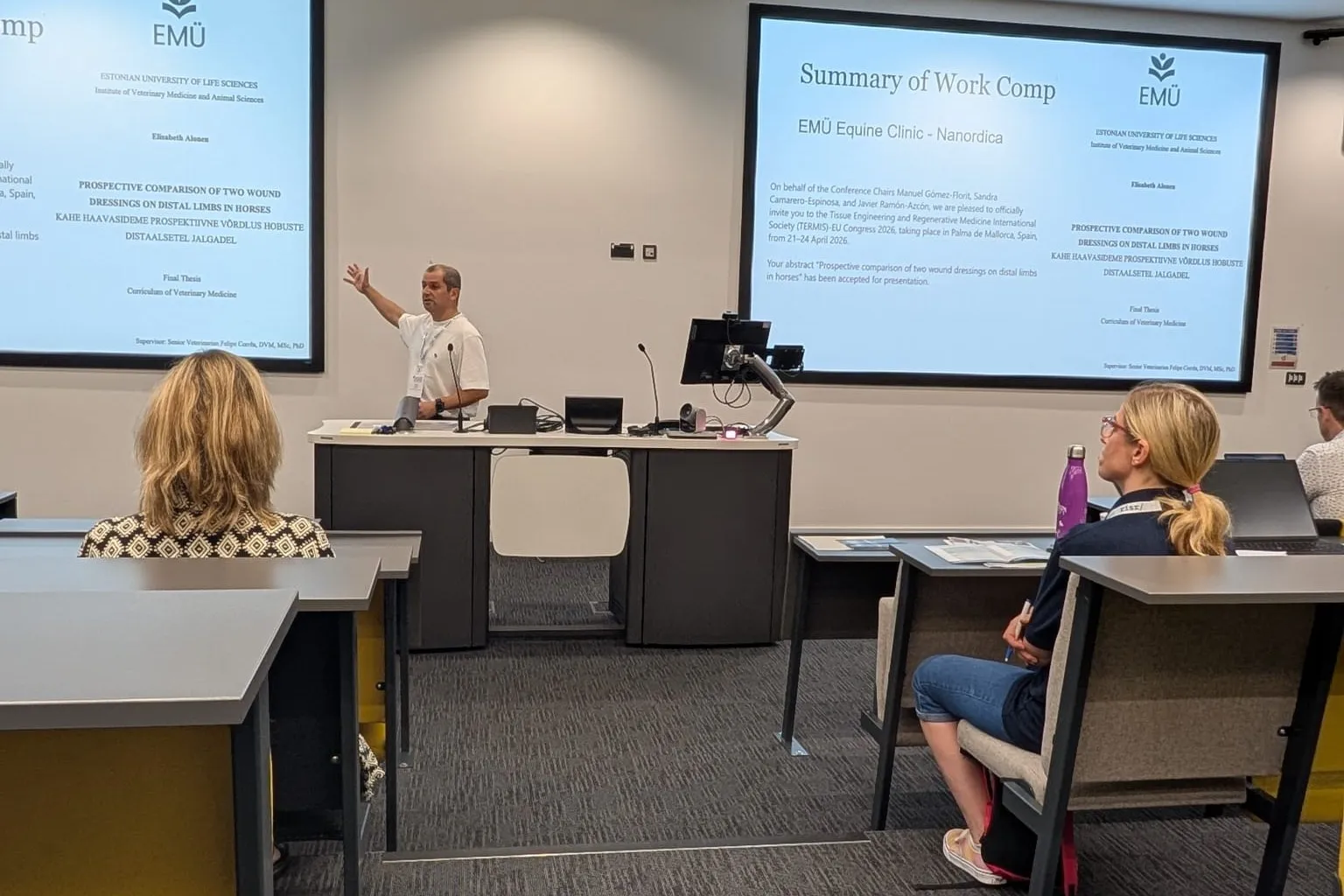
Over the past four years, the Equine Clinic has developed an educational approach that combines early clinical exposure, supervised hospital activities and night shifts, student participation in research and public engagement, collaboration with public and private partners, and the use of social media to support learning and communication. The learning environment also includes the student-led Hyraco Association and Estonia’s first BEVA-recognised Equine Internship Programme.
Seven presentations at VetEd 2026 introduced different aspects of this work to an international audience of veterinary educators and other professionals. Topics included early clinical immersion through supervised night shifts, student involvement in research and outreach, collaboration with external partners, the development of the Hyraco Association, the educational use of social media, and the establishment of the BEVA-recognised Equine Internship Programme.
Head Veterinarian of the Equine Clinic Felipe Corrêa represented the Estonian University of Life Sciences at the symposium and presented the clinic’s experiences and educational initiatives. The presentations generated interest among participants and led to discussions on curriculum development, experiential learning and clinical education. Representatives of other veterinary schools were particularly interested in approaches to early clinical immersion, student engagement and the integration of extracurricular learning into veterinary education.
Participation in VetEd 2026 also provided opportunities to exchange experiences with colleagues from veterinary schools and institutions around the world, establish new contacts for international collaboration, and take part in faculty development activities focusing on teaching methods, student engagement, curriculum design, assessment and clinical teaching. The knowledge and professional connections gained at the symposium will contribute to the further development of veterinary education at our university.
The development of the Equine Clinic’s learning environment has been a collaborative effort involving clinicians, researchers, educators and students. Special thanks go to Reet Herm, Egne Kahro, Maria Kivastik, Sebastian Langui, Roxane Le Coat, Emma Lakovaara and Triinu Vasiljeva, whose contributions have played an important role in developing and implementing these educational initiatives.
The next VetEd symposium will be hosted by the University of Cambridge in 2027, providing another opportunity to share experiences and continue international collaboration in veterinary education.
Toimetaja:

Communications specialist
Institute of Veterinary Medicine and Animal Sciences
Administration of the Institute of Veterinary Medicine and Animal Sciences
5265488
5265488Additional information:

Head Veterinarian of an Equine Clinic
Institute of Veterinary Medicine and Animal Sciences
Chair of Clinical Veterinary Medicine
Animal Clinic
