
When Helena-Krõõt Haidak applied to university after graduating from upper secondary school, she originally wanted to become a veterinarian. Instead of veterinary medicine, her mother suggested that she consider animal science – and within her very first week of studies, Helena-Krõõt realised she had found the right field.
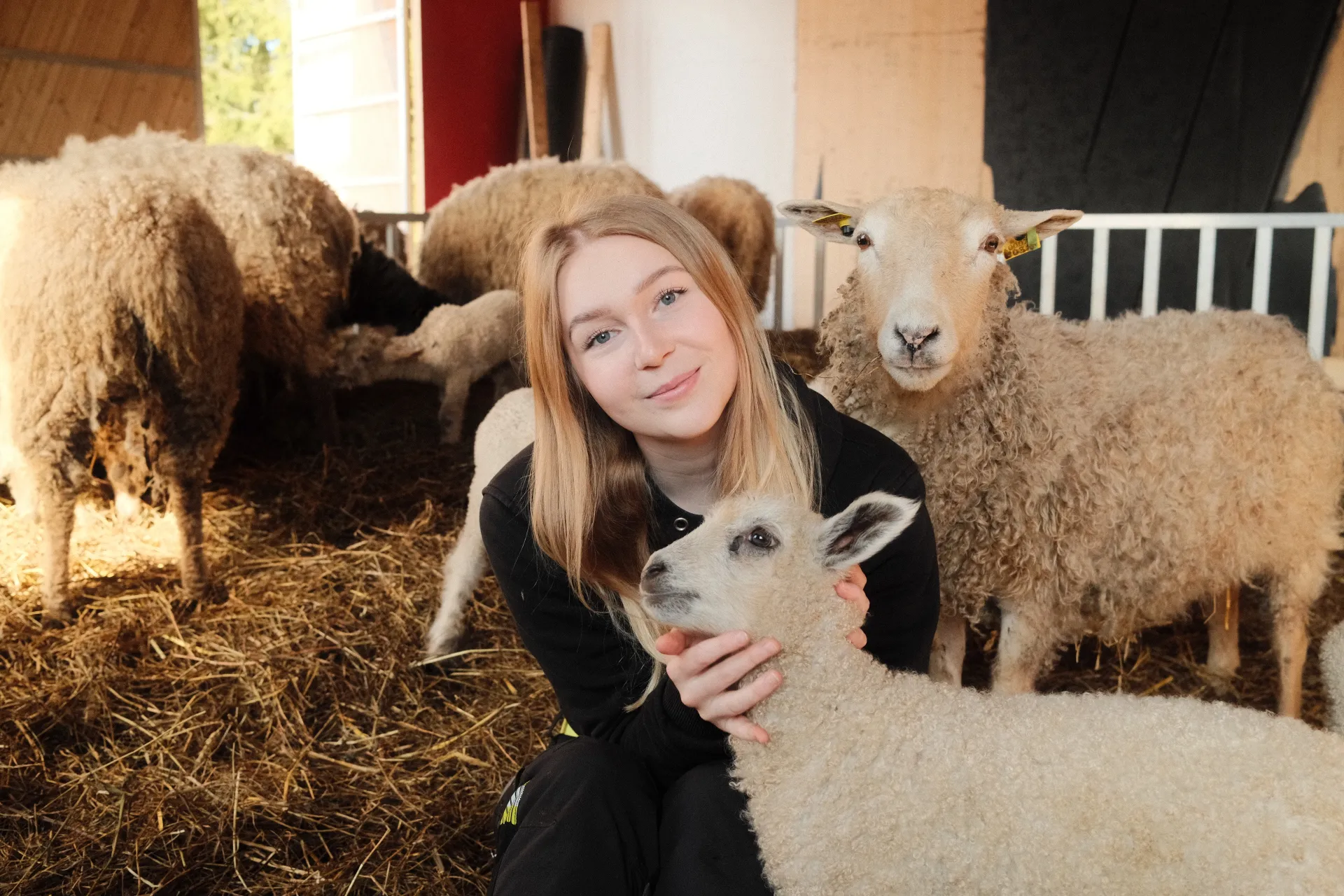
“I realised that I wanted to work with healthy animals, not sick ones. Animal science turned out to be exactly the right field for me.”
Today, Helena-Krõõt holds a Master’s degree in Animal Science from the Estonian University of Life Sciences. She works as a breeding specialist at the Estonian Sheep and Goat Breeders Association, raises her own sheep, and plans to pursue a PhD next.
Modern animal science may surprise you
According to Helena-Krõõt, one common misconception about animal science is that the work mainly involves looking after animals in a barn. In reality, the field is far more diverse.
“Today, animal science is very much a precision science. We use new technologies and sensors, collect data and analyse it – and that is also what I do in my everyday work.” Animal welfare, sustainability and food security are also becoming increasingly important. All of this means that the field needs skilled specialists and fresh ideas.
Helena-Krõõt has found that the knowledge of young professionals is valued. “There is no attitude of ‘you’re young, so you don’t know anything’. Quite the opposite – people say, ‘You’ve just come from university, tell us how we could do things differently.’”
Studies that give you real hands-on experience
One of the things Helena-Krõõt valued most about her Master’s studies was the strong practical focus. Students visited farms and companies, giving them an opportunity to see the wide range of solutions used in modern animal production.
“Animal science is anything but one-dimensional. You get to see how businesses actually operate and talk to people who work in the field. It’s inspiring.”
Her practical experience also led directly to a job in the sector. After completing an internship during her Bachelor’s studies, Helena-Krõõt was invited to work for the Estonian Sheep and Goat Breeders Association. Thanks to the flexible study format of the Master’s programme, she was able to combine her studies with work, with the support of her employer.
“The study format didn’t interfere with my work, and my work didn’t interfere with my studies. Of course, you have to manage your time, but for me it worked very well.”
From a Master’s internship to a sheep flock of her own
During her Master’s studies, Helena-Krõõt took another important step: instead of looking for an internship placement, she decided to get sheep of her own. “I thought, why go somewhere else for an internship? I’ll get my own sheep. And now I’m a sheep farmer.”
Having her own flock has also made the issue of food security even more personal for her. “I know where my food comes from. That matters to me.”
“There is no shortage of work in this field”
For anyone considering a Master’s degree in Animal Science, Helena-Krõõt highlights another very practical reason to take the leap.
“There is definitely no shortage of work. Even while studying, I had to turn down several job offers.”
According to Helena-Krõõt, the professional contacts, practical experience and deeper specialist knowledge gained during her studies open up a wide range of opportunities. Her own next step is a PhD, but she also intends to continue raising sheep.
Most importantly, however, the work has a clear sense of purpose. “You can see the results of your work. Animal science comes with a lot of responsibility because you are working with living beings. It is incredibly meaningful work,” Helena-Krõõt concludes.
Toimetaja:
